KNX vs Zigbee: Which Protocol Fits Indian Homes?
KNX or Zigbee? The wrong choice means redoing civil work. Here's which protocol wins for Indian homes — based on construction stage and budget.

By Abhi Bavishi

Pick the wrong smart home protocol and you'll be redoing civil work you never wanted to do.
KNX installers in India routinely quote ₹8–20 lakh for projects that a Zigbee system handles for ₹2–4 lakh. But pick Zigbee for the wrong situation and you'll hit walls — literally.
This guide tells you exactly when KNX wins and when Zigbee is the smarter call — based on your home type, construction stage, and budget.
KNX is a wired protocol built for buildings under construction — not finished homes
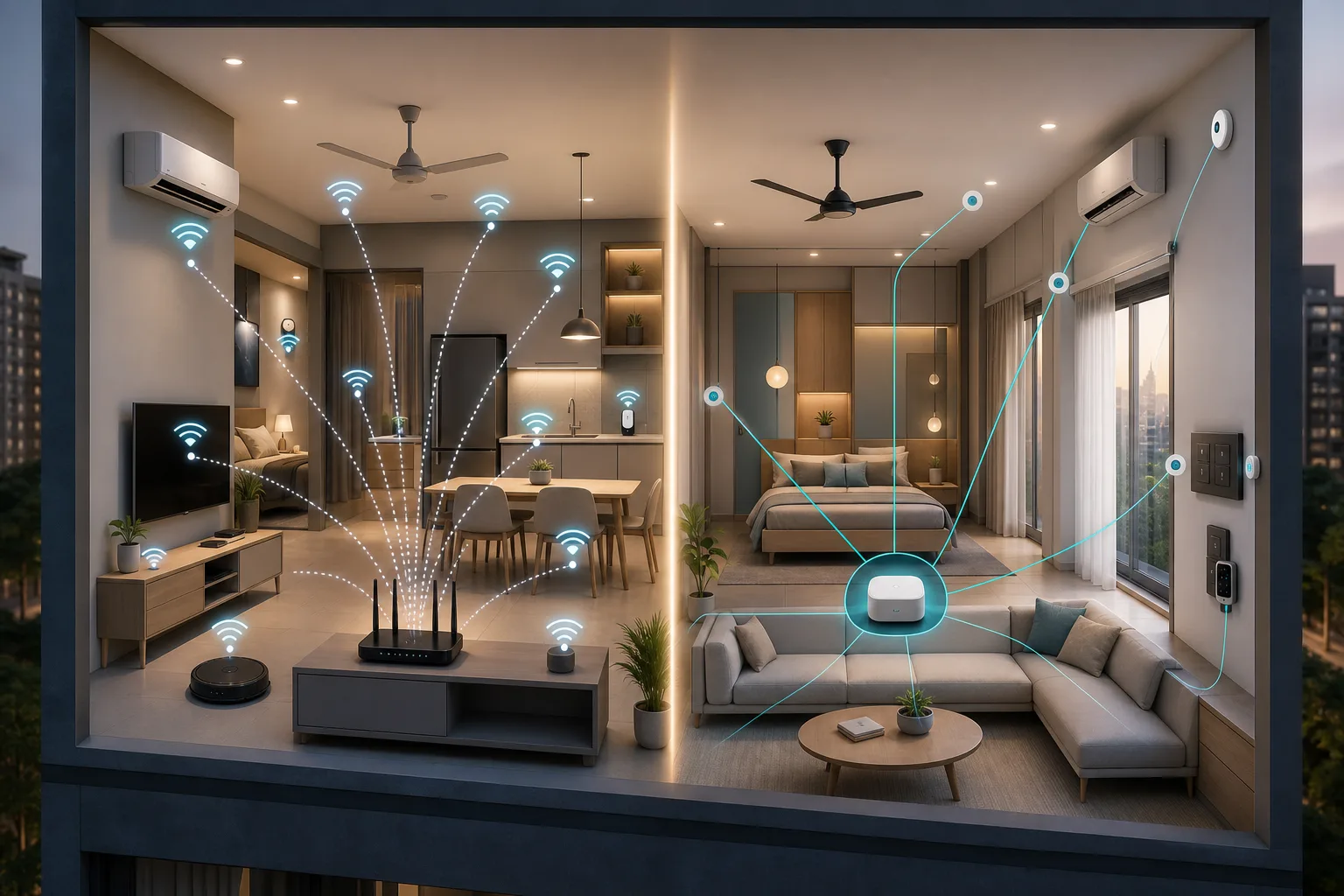
KNX runs on a dedicated 2-wire bus cable embedded in walls during construction. Every switch, sensor, and actuator talks over this bus. You cannot retrofit KNX into a completed home without major civil work — hacking walls, pulling cable, replastering.
In India, KNX shows up in luxury bungalows, 5-star hotels, and premium commercial projects. Brands like Schneider Electric, ABB, Siemens, and Legrand all make KNX-certified products. Installation requires a certified KNX programmer. A full project typically takes 3–6 months.
- Dedicated wired bus — zero wireless interference
- Scales to thousands of devices for large commercial use
- Interoperable across 500+ certified manufacturers globally
- Must be planned before construction begins
- Higher device and installation costs than any wireless alternative
Zigbee is wireless and installs in any finished home without touching a wall
Zigbee operates on the 2.4 GHz band and forms a self-healing mesh — devices talk to each other directly, extending coverage automatically as you add more. A small hub connects the whole network to your phone and the internet.
Zigbee switches slot into your existing gang boxes. No drilling. No rewiring. A full 2BHK installation typically wraps up in one to two days.
Most retrofit smart home brands in India — including Aqara, Philips Hue, and Smartify — are built on Zigbee. It supports up to 65,000 devices per network, so it scales well past anything a typical home needs.
KNX vs Zigbee: side by side
| Factor | KNX | Zigbee |
|---|---|---|
| Installation | Wired — during construction only | Wireless — retrofit anytime |
| 3BHK project cost | ₹8–25 lakh | ₹1.5–4 lakh |
| Reliability | Excellent (dedicated bus) | Very good (mesh) |
| Device limit | Effectively unlimited | 65,000 per network |
| Installers in India | Limited — KNX-certified only | Wide availability |
| Voice assistants | Indirect (via gateway) | Native Alexa, Google Home, Siri |
| Renter-friendly | No | Yes — removable |
| Future-proofing | 30+ year standard | Matter-compatible (evolving) |
KNX makes sense for large new-construction homes above 4,000 sq ft
If you're building from scratch — large bungalow, villa, or a premium residential project — and your architect is already coordinating MEP services, KNX is worth the investment. The wired bus delivers reliability no wireless protocol matches at scale. You'll never deal with interference, mesh drops, or range limitations.
It also makes sense for property developers who want to spec a certified smart home system into their project as a buyer differentiator.
But if your home is already built? KNX is off the table unless you're willing to gut the walls.
Zigbee is the right call for most Indian homeowners
Apartments, builder flats, independent houses already standing, rented properties — Zigbee handles all of it. Here's what that looks like in practice:
- No civil work. Switches replace your existing switches in the same gang boxes.
- Starts at ₹2 lakh for a complete 2BHK — lighting, curtains, AC control, and security.
- Renter-friendly. No permanent installation. Take it when you move.
- One to two days to install. Not three to six months.
KNX and Zigbee can run together in the same home
Hybrid installations are common in large bungalows. The core wired infrastructure — main lighting circuits, HVAC — runs on KNX. Sensors, IR blasters, and secondary devices run on Zigbee. Gateways like the Smartify Convergia bridge both protocols into one app.
This gives you wired reliability where it matters and wireless flexibility everywhere else.
The bottom line
Building a large home from scratch with a serious automation budget? Get a KNX assessment. For everyone else — which is most of India — Zigbee delivers 90% of KNX's functionality at a fraction of the cost, without touching a wall.
Book a free consultation to see what Zigbee-based automation looks like for your home.
Frequently asked questions
Can I add KNX to my existing home?
Not without significant civil work. KNX requires dedicated bus cable embedded in walls during construction. If your home is already built, Zigbee is the practical alternative.
Is Zigbee reliable enough for a full home automation system?
Yes. Zigbee's mesh architecture means devices communicate through each other, not just through your router. Most homes with 20–100 Zigbee devices experience near-zero reliability issues.
Which protocol do smart home companies in India mostly use?
Most retrofit-focused companies use Zigbee — including Smartify, Aqara, and Philips Hue. KNX is used by systems integrators for large new-construction projects.
Does Zigbee work with Alexa and Google Home?
Yes, natively. Zigbee hubs integrate directly with Amazon Alexa, Google Home, and Apple HomeKit (via Matter or dedicated bridges).