Best IR Blasters for AC and TV Control in India 2026
Smartify IR Blaster, Broadlink RM4 Pro, SwitchBot Hub Mini, Zemote, Tuya IR hubs — compared for Indian AC brands, device database depth, and smart home integration.

By Abhi Bavishi
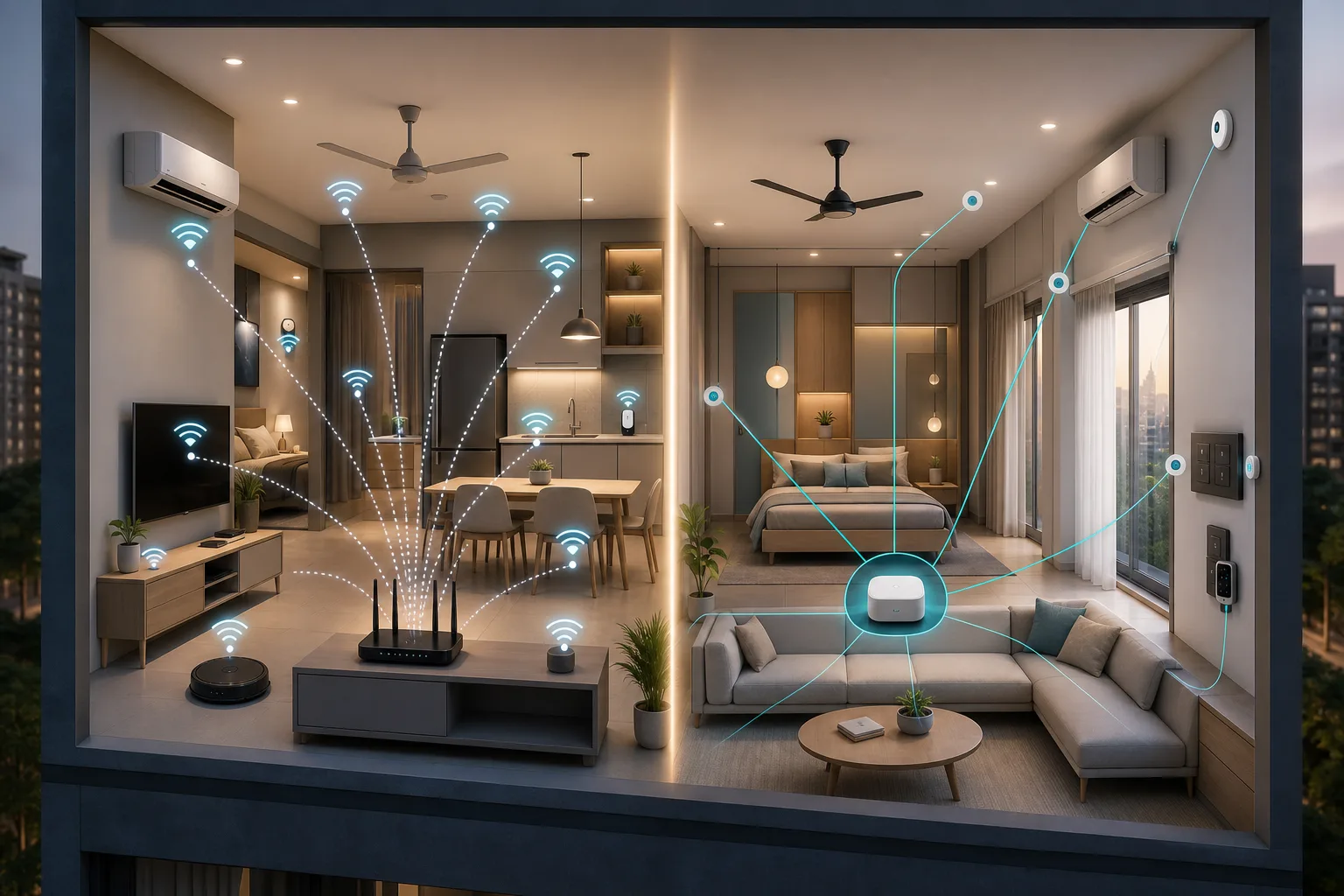
An IR blaster turns any dumb AC or TV into something you can control from your phone, automate on a schedule, and include in scenes. It's one of the highest-value additions to an Indian smart home, because most homes have 2–4 split ACs that can't be replaced easily, and controlling them via IR is the only retrofit option that doesn't require touching the AC unit itself.
But not all IR blasters are equal. The right one for your home depends on how many devices you need to control, whether Indian AC brands are in the database, how well it integrates with your broader smart home setup, and whether you need it standalone or embedded in a wider ecosystem.
What an IR blaster actually does (and its limitations)
IR blasters emit infrared signals — the same as your AC remote — to control devices. They work line-of-sight within a room: one IR blaster typically covers a single room unless it has wide-angle or multi-directional emitters. If you have ACs in multiple rooms, you generally need one IR blaster per room, or one with external emitter cables you can route.
What IR control cannot do: IR is one-directional. You can send commands to your AC, but you cannot read back the current state. If someone manually changes the AC temperature with the physical remote, your app won't know. This is a fundamental limitation of IR — not a flaw of any specific product.
For true two-way AC control with state feedback, you need native WiFi-enabled ACs or a Daikin/Mitsubishi/Hitachi gateway module that interfaces directly with the indoor unit. IR blasters are the next-best thing when you can't replace the AC unit.
Indian AC brands and device databases
The most common AC brands in Indian homes — Daikin, Voltas, Blue Star, Hitachi, Carrier, LG, Samsung, and Panasonic — are well-supported in most IR blasters. However, the quality of support varies: some databases have basic ON/OFF/temperature functions, while better implementations support mode (cool/dry/fan), fan speed, swing, and sleep mode.
For older or less-common Indian brands (Videocon, O General older units, regional brands), database coverage can be patchy. If you have an older or uncommon AC, check whether the specific IR blaster supports learning mode — the ability to capture signals directly from your existing remote and store them, bypassing the database entirely.
The five options we're comparing

Smartify IR Blaster (WiFi + RF)
Our IR blaster is designed as part of the broader Smartify Zigbee ecosystem, though it connects to your home WiFi directly (not via Zigbee) since IR control doesn't require the low-latency mesh benefits that switches need. It supports infrared for ACs, TVs, set-top boxes, and DVD players, plus 433 MHz RF for RF remotes (ceiling fans, some older AC models).
The key advantage for existing Smartify customers is native scene integration: your IR commands can be included in the same automations as your Zigbee lights, curtains, and sensors. A Good Night mode can simultaneously dim the bedroom lights, close the curtains, set the AC to 24 degrees, and lock the front door — all from one trigger. The device database covers all major Indian AC brands with full parameter control (mode, fan speed, sleep, swing).
Price: ₹2,800–₹3,500. Protocol: WiFi + RF 433 MHz. Rooms: One per device (use multiple for multiple rooms).

Broadlink RM4 Pro
Broadlink is the most widely used standalone IR blaster globally, and the RM4 Pro is their current flagship. It supports IR plus RF 433/315 MHz and has one of the deepest device databases available — thousands of AC models including most Indian brands. The IHC app is functional, and Broadlink integrates with Alexa, Google Home, IFTTT, and — for advanced users — Home Assistant.
The Broadlink app experience is utilitarian rather than elegant. Setting up complex scenes requires some patience. But for pure IR control across many device types, Broadlink's database depth and RF support is hard to match at this price. It's our recommendation for buyers who want excellent standalone IR control and don't already have a Smartify or Aqara hub.
Price: ₹3,000–₹4,500. Protocol: WiFi + RF 433/315 MHz. Rooms: One per device.
SwitchBot Hub Mini
SwitchBot's Hub Mini is compact, well-designed, and integrates natively with the SwitchBot ecosystem — which includes their smart curtain motors, plugs, and sensors. For buyers building a SwitchBot-centric smart home, the Hub Mini makes sense as a combined hub and IR blaster.
As a standalone IR blaster, it's competitive: good device database, reliable WiFi connectivity, Alexa and Google Home support, and a clean companion app. RF support is not included (IR only), which limits control of RF-based ceiling fans and RF remotes. For homes with only IR-based appliances, this isn't a limitation. For mixed IR+RF needs, Broadlink or Smartify's IR+RF model is more versatile.
Price: ₹3,500–₹5,000. Protocol: WiFi (IR only, no RF). Rooms: One per device.
Zemote Z5
Zemote is an Indian product targeting the premium end of the standalone IR blaster market. The Z5 has a 360-degree emitter design that provides better room coverage than forward-facing blasters. Device support for Indian brands is solid, and the app has a relatively polished remote-like interface.
Zemote's ecosystem is limited — it's primarily a standalone IR blaster with voice assistant support but limited integration into broader smart home platforms. If you want a single, well-engineered IR blaster that handles all your room's appliances without needing a broader ecosystem, Zemote is worth considering. For multi-room, multi-device setups where scene integration matters, other options are more capable.
Price: ₹3,000–₹4,000. Protocol: WiFi (IR only). Rooms: One per device (360-degree coverage helps).

Generic Tuya IR Blasters
Tuya-based IR blasters appear on Amazon and Flipkart under a dozen brand names at ₹600–₹1,500. They work via the Tuya Smart app and integrate with Alexa and Google Home. Many also work with Home Assistant via the local Tuya integration.
For basic ON/OFF/temperature control of mainstream AC brands, they get the job done. The device database is often limited, learning mode is present but variable in reliability, and build quality varies widely across Tuya resellers. The app is adequate but not great. If you want to experiment with IR control at minimal cost, a Tuya IR blaster is a low-risk entry point. For anything beyond basic control, invest in a named brand.
Price: ₹600–₹1,500. Protocol: WiFi (IR only, some with RF). Rooms: One per device.
Comparison table
| Product | Protocol | RF support | Indian AC database | Scene integration | Price |
|---|---|---|---|---|---|
| Smartify IR Blaster | WiFi | Yes (433 MHz) | Excellent | Native Smartify scenes | ₹2,800–₹3,500 |
| Broadlink RM4 Pro | WiFi | Yes (433/315 MHz) | Excellent | IFTTT, Alexa, HA | ₹3,000–₹4,500 |
| SwitchBot Hub Mini | WiFi | No | Good | SwitchBot ecosystem | ₹3,500–₹5,000 |
| Zemote Z5 | WiFi | No | Good (Indian focus) | Basic Alexa/Google | ₹3,000–₹4,000 |
| Tuya Generic | WiFi | Sometimes | Basic | Alexa/Google/HA | ₹600–₹1,500 |
Multi-room setups — what you actually need
A common mistake is buying one IR blaster and expecting it to control ACs in multiple rooms. IR is line-of-sight and limited in range. For a 3BHK with ACs in the living room, master bedroom, and a second bedroom, you need three separate IR blasters — one per room.
Some products (Broadlink, Smartify) support external IR emitter cables that you can tape to point directly at a specific device's receiver. This helps in situations where the blaster can't be placed in the direct line of sight of the AC indoor unit (blocked by furniture, ceiling beams, etc.).
AC control precision — what full control means
Basic IR control: ON, OFF, temperature up/down. This is what cheap Tuya blasters offer for most AC brands.
Full IR control: ON/OFF, temperature (any setpoint), mode (cool/heat/dry/fan), fan speed (auto/low/medium/high), swing direction, sleep mode, timer. This is what Broadlink and Smartify support for all major Indian AC brands.
Full control is significantly more useful for automation. A Good Night scene that sets the AC to 26 degrees, cool mode, low fan speed, and sleep mode on a 6-hour timer is meaningfully better than just turning it on.
To integrate IR blasters into full home automation scenes, book a free consultation with our team. Or use the cost calculator to see how IR control fits into your overall smart home budget.
Frequently asked questions
Can one IR blaster control ACs in multiple rooms?
Generally no. IR signals are directional and limited in range. You typically need one IR blaster per room. Some products support external IR emitter cables to cover multiple devices from one unit within a single room, but for separate rooms you need separate units.
Will an IR blaster work with my old AC that has a physical remote?
Almost certainly yes. All the products reviewed here support IR learning mode — you can point your existing remote at the blaster and it captures the signals directly. This bypasses the need for database support and works with virtually any IR remote, regardless of brand or age.
Do IR blasters work without internet?
Local triggers (automations on a schedule, running from your phone on the same WiFi network) work without internet on most products. Control from outside your home requires internet. Voice control via Alexa or Google also requires internet.
Can I control my inverter split AC's exact features via IR?
Yes, for supported brands. Broadlink and Smartify support full parameter control (temperature, mode, fan speed, swing, sleep) for Daikin, Voltas, Blue Star, Hitachi, Carrier, LG, Samsung, Panasonic, and other major Indian brands. Basic Tuya blasters may only support temperature and ON/OFF for some models. Check database support for your specific AC model before buying.