Best Smart Switches in India 2026: Honest Buyer's Guide
Smartify TAC series, Aqara, Schneider Wiser, Wipro Smart, Sonoff, Wozart — compared honestly for Indian gang boxes, neutral wire requirements, and real-world reliability.

By Abhi Bavishi

Smart switches are the single biggest decision in any home automation project. Get them right and everything else falls into place. Get them wrong and you're staring at mismatched gang boxes, neutral wire problems, and an app that crashes when you need it most.
We've installed hundreds of smart switch systems across India — in Mumbai apartments with 1960s wiring, newly-built Bengaluru villas, and everything in between. Here's what actually works.
The Indian smart switch problem nobody talks about
Most smart switch reviews are written for American or European homes. Indian homes are different in ways that matter enormously:
- Neutral wire availability. Many Indian wiring setups — particularly older construction — run 2-wire loops without a neutral at the switch box. Several smart switches require a neutral wire to power their electronics. No neutral means no dice, or you need a workaround like a bypass capacitor.
- Modular gang box sizes. India uses a 3M (3 module) and 6M (6 module) modular plate system — very different from US toggle switches or European Schuko standards. Smart switches must physically fit these plates, or you need to replace the entire plate assembly.
- Voltage fluctuations. India's grid runs nominally at 230V/50Hz but real-world voltages in many cities swing between 200V and 260V. Budget smart switches with cheap internals fry under these conditions.
- Power cuts and UPS loads. When power returns after a cut, there's often a voltage spike. Quality smart switches handle this; cheap ones reset or brick.
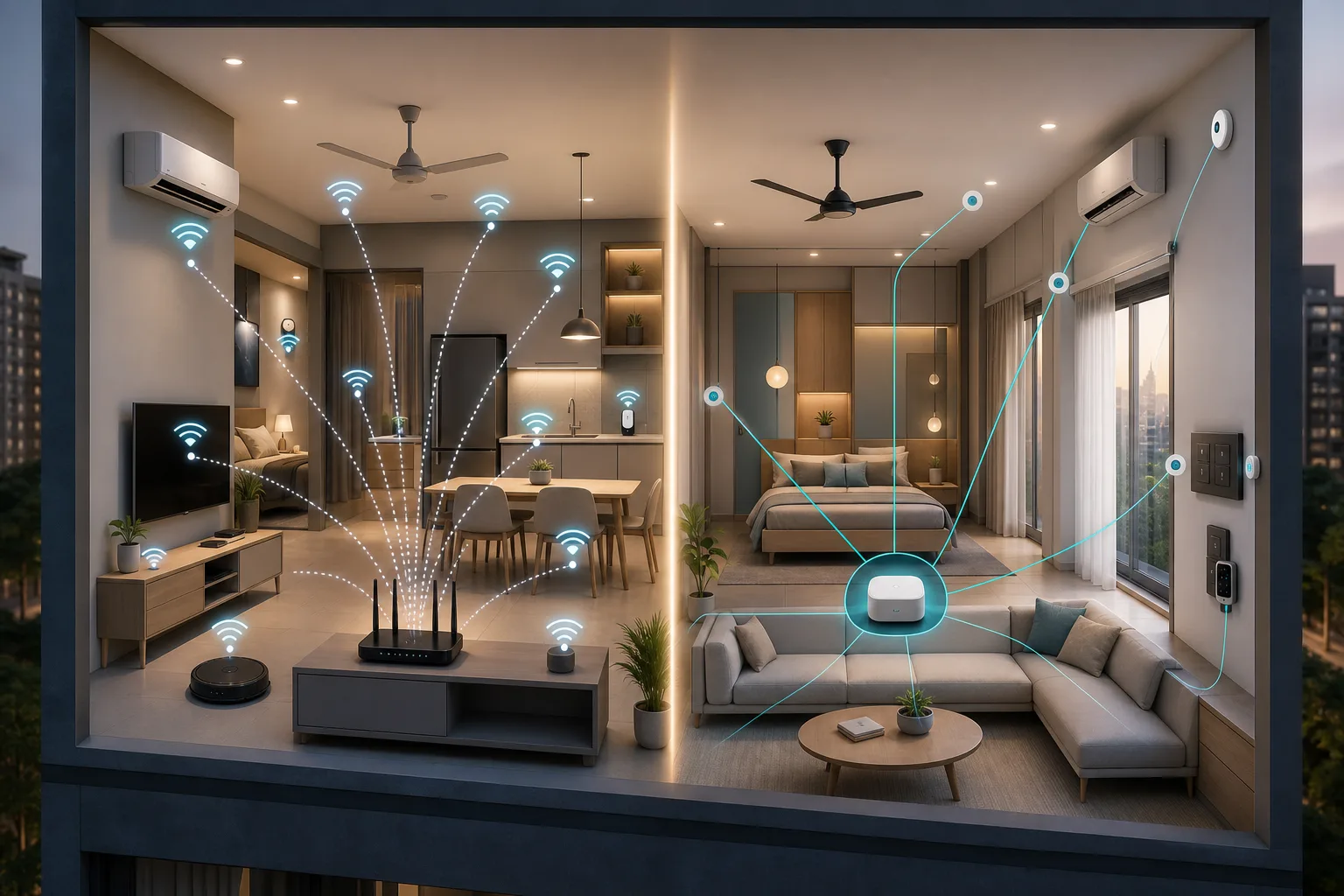
- Humidity and concrete walls. Coastal cities like Mumbai and Chennai see high humidity year-round. Zigbee mesh handles this better than WiFi because short mesh hops stay reliable through thick concrete walls.
The six options we're comparing

Smartify TAC Series
Our own range of Zigbee-based modular smart switches, designed from the ground up for Indian gang boxes. The TAC series comes in 1-gang through 6-gang configurations, fits standard 3M and 6M modular plates, and is available with or without neutral wire variants. The TAC HL adds a high-load variant rated for heavier appliances like geysers and 1.5-ton ACs.
Because we design and install these ourselves, we can vouch for the voltage tolerance — they're rated for 85V–265V AC, which covers the realistic worst-case across Indian cities. The Zigbee mesh means adding more switches improves network stability rather than degrading it. Scene integration with curtain motors, IR blasters, and sensors is seamless since everything runs on the same hub.
Price range: ₹1,800–₹3,500 per switch module. Protocol: Zigbee 3.0. Neutral required: No (neutral-free variant available).

Aqara (D1 Series and newer)
Aqara's smart switches are among the most mature Zigbee products available in India. The D1 series supports 1–3 gang configurations without a neutral wire — a significant advantage. Build quality is solid, the Aqara Home app is genuinely good, and HomeKit support is a real differentiator for Apple users.
The main limitation is the plate form factor. Aqara switches ship in their own housing designed for the Chinese market. In Indian homes, you typically need an adapter plate or a completely new face plate, which adds cost and complexity. Installation also requires pairing through the Aqara hub first, which means the hub is mandatory even for basic use.
Price range: ₹2,500–₹4,500 per module (imported). Protocol: Zigbee 3.0. Neutral required: No (D1 series).

Schneider Wiser
Schneider's Wiser system uses Zigbee and looks excellent — the switches have a premium tactile finish that holds up in high-end homes. The brand name carries weight with architects and interior designers. Schneider's service network across India is one of the best in the business.
The honest limitation is price. Wiser switches run ₹3,500–₹6,500 per module, making a fully-automated 3BHK an ₹8–12 lakh hardware exercise before installation. The Wiser ecosystem is also relatively closed — you can't easily add third-party Zigbee sensors or IR blasters. If you're building a mixed-device smart home, Wiser creates integration headaches.
Price range: ₹3,500–₹6,500 per module. Protocol: Zigbee. Neutral required: Varies by model.

Wipro Smart
Wipro's smart switches are WiFi-based and competitively priced at ₹1,200–₹2,500 per module. They fit standard Indian modular plates and are available through electrical wholesalers across the country — making them the easiest to source outside metros.
WiFi smart switches work fine at 5–10 devices. As you scale beyond 15–20 switches, the per-device WiFi client model starts taxing your router, and reliability in thick-walled apartments degrades. Wipro's app quality has improved but still lags behind Aqara or Smartify in automation depth. If you want a basic setup in a small flat and want to buy from your local electrical shop in Coimbatore or Lucknow, Wipro is a legitimate choice.
Price range: ₹1,200–₹2,500 per module. Protocol: WiFi. Neutral required: Yes.

Sonoff (via ITEAD)
Sonoff's switches are the darling of the DIY community. The T-series wall switches are WiFi-based, reasonably priced at ₹1,000–₹2,000, and have a huge community behind them — including Tasmota firmware for local control without any cloud dependency.
For everyday Indian buyers, Sonoff has practical challenges: availability is primarily through Amazon imports, warranty and after-sales support in India is limited, and the touch-panel aesthetic doesn't match premium interiors. The eWeLink app is functional but not exceptional. Sonoff is best suited for technically-inclined buyers who want to tinker, or those building budget-focused setups where DIY support is acceptable.
Price range: ₹1,000–₹2,000 per module. Protocol: WiFi (Zigbee models also available). Neutral required: Yes (most models).

Wozart
Wozart is an Indian brand making WiFi smart switches specifically designed for the Indian modular plate system. Their FingerX touch switches look sharp and are priced in the ₹2,000–₹3,500 range. They offer 2-year warranty support with service centers in major cities.
Wozart's ecosystem is limited — mostly switches and plugs, with no native Zigbee sensors or curtain motors to integrate. For buyers who want a clean, India-made switch solution without building a full automation ecosystem, Wozart is worth considering. For full home automation, you'll hit integration ceilings quickly.
Price range: ₹2,000–₹3,500 per module. Protocol: WiFi. Neutral required: Yes.
Comparison table
| Brand | Protocol | Neutral-free? | Indian plate fit | Price/module | Best for |
|---|---|---|---|---|---|
| Smartify TAC | Zigbee 3.0 | Yes | Native 3M/6M fit | ₹1,800–₹3,500 | Full home automation |
| Aqara D1 | Zigbee 3.0 | Yes | Needs adapter plate | ₹2,500–₹4,500 | Apple HomeKit users |
| Schneider Wiser | Zigbee | Varies | Own plate system | ₹3,500–₹6,500 | Premium new-build homes |
| Wipro Smart | WiFi | No | Native modular fit | ₹1,200–₹2,500 | Small setups, wide availability |
| Sonoff T-series | WiFi/Zigbee | No (most) | Non-standard | ₹1,000–₹2,000 | DIY/tinkerers |
| Wozart FingerX | WiFi | No | Standard modular | ₹2,000–₹3,500 | India-made, basic setups |
Which should you choose?
For a complete smart home with scenes, sensors, curtains, and AC control: choose a Zigbee ecosystem — either Smartify TAC or Aqara. The mesh reliability in concrete apartments is real, and the integration depth with other devices is far superior to WiFi-only systems.
For a premium aesthetic in a new-build apartment where budget isn't the primary concern: Schneider Wiser is a defensible choice if you're committed to the Wiser ecosystem and have an architect specifying it.
For a tight budget or small rental setup: Wipro Smart or Wozart give you basic app and voice control without overspending on a short-term home.
For a neutral wire problem: Don't force a neutral-required switch with a workaround. Use a Smartify TAC neutral-free variant or an Aqara D1 — both are engineered for this scenario.
Not sure how many switch points you'll need or what the full setup costs? Use our cost calculator or book a free consultation — we'll assess your home's wiring before recommending anything.
Frequently asked questions
Do smart switches work without a neutral wire in Indian homes?
Yes, but only specific models. The Smartify TAC neutral-free variant and Aqara D1 series both work without a neutral wire. Most WiFi-based switches (Wipro, Wozart, Sonoff) require a neutral wire. If you're not sure what wiring you have, any licensed electrician can check in under 10 minutes — ask them before buying.
Do smart switches fit standard Indian modular plates?
Smartify TAC and Wipro Smart switches are designed for Indian 3M and 6M modular plates. Aqara switches need an adapter plate. Schneider Wiser uses its own plate system. Always confirm physical compatibility before ordering, especially if you have Anchor, Legrand, or GM modular plates with custom-sized cutouts.
WiFi vs Zigbee — which is better for Indian apartments?
For small setups (under 10 devices), WiFi is simpler. For full home automation in a concrete apartment building, Zigbee is significantly more reliable. The mesh architecture handles thick walls better, doesn't saturate your router, and continues working locally during internet outages.
Can smart switches handle Indian voltage fluctuations?
Quality smart switches — Smartify TAC, Aqara, Schneider Wiser — are rated for wide input voltage ranges (85–265V) and handle typical Indian fluctuations without issue. Avoid very cheap switches that don't publish their input voltage specifications; these are the ones that fail during voltage spikes after a power cut.