Best Smart Home Security Systems in India (2026)
Qubo, CP Plus, Hikvision, Mi cameras, Aqara sensors, Smartify — compared for Indian homes on local storage, false alarms, power backup, and integration with automation.

By Abhi Bavishi
Smart home security in India means something different from what most international guides assume. Power cuts are real. Concrete walls affect WiFi camera feeds. Many Indian apartments have restrictions on external camera installation. And the notion of a professional monitoring service with 10-minute police response times that underpins Western security product marketing doesn't translate to most Indian cities.
What Indian homeowners actually need from smart home security: immediate mobile alerts when something happens, reliable video evidence they can share with housing society security or police, sensors that catch events even when cameras can't see them, and a system that keeps working when Jio or BSNL has a bad day.
Here's how to build that, and which products deliver it.
The two layers of a proper smart home security system
A well-designed system has two complementary layers:
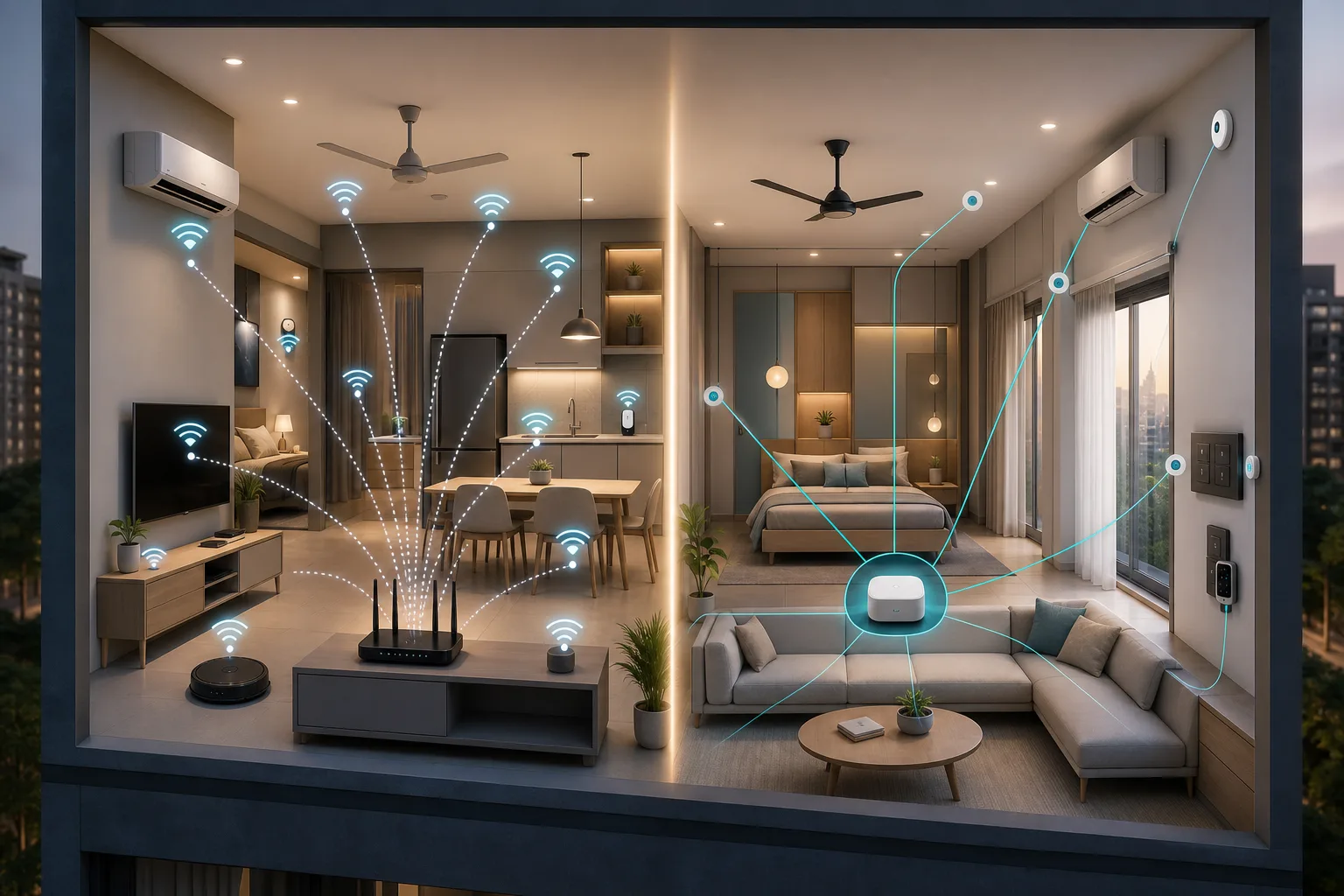
- Detection sensors: Door/window contact sensors, motion (PIR) sensors, and glass break sensors that trigger when an entry attempt is made — even before anyone is visible on camera. These are Zigbee-based, battery-powered, and work without internet.
- Video cameras: For visual confirmation, deterrence, and evidence. WiFi cameras that stream to your phone and record locally or to the cloud.
Many buyers focus only on cameras and skip sensors. This is a mistake. A camera tells you what happened after the fact. A door sensor tells you the moment a door opens, day or night, whether the camera angle covers it or not. Sensors are cheap (₹1,500–₹3,000 each) and should cover every accessible entry point: main door, back door, terrace door, accessible windows.
Local vs cloud storage — the Indian context
Cloud storage sounds convenient. But consider: if your internet is down during a break-in, your cloud camera records nothing. If your router loses power during the same event, same result. Indian homes need local storage as the primary recording layer, with cloud as a secondary option for remote playback.
Local storage means SD card in the camera (most cameras accept 64GB–256GB microSD) or a local NVR (Network Video Recorder) box. An SD card at 1080p/15fps gives roughly 3–5 days of continuous recording on a 128GB card before it loops. That's adequate for most use cases.
An NVR connected to a UPS or inverter keeps recording through power cuts. This matters enormously: professional thieves in India know that cutting power to the building is step one. A camera without backup power goes dark the moment this happens. A camera with its own battery backup or connected to an inverter circuit keeps recording.
Power backup options
- Camera with built-in battery: Some cameras (like certain Qubo and Arlo models) have internal batteries. Runtime is typically 2–4 hours — adequate for brief power cuts but not extended outages.
- Camera on inverter circuit: Connect your cameras and WiFi router to an inverter/UPS output. This is what we recommend for permanent installations — seamless backup without battery management.
- Small UPS for router: A dedicated mini-UPS for your router (₹1,500–₹3,000) keeps the network up during cuts, allowing cameras connected to mains power to continue streaming even when the main power is off (they'll cut out, but you'll still get alerts from sensor-based detection).
The products we're comparing

Qubo Smart Camera (Hero Group)
Qubo has quickly become one of India's most credible smart camera brands. Made by Hero Group (yes, the motorcycle company), Qubo cameras are designed specifically for Indian conditions — including humidity tolerance, wide voltage input, and a subscription model that's reasonably priced for Indian budgets.
The Qubo Pro Camera 360 offers 360-degree coverage, 1080p video, AI-based motion detection with human detection (to reduce false alerts), local SD card storage up to 128GB, and optional cloud storage from ₹99/month. The app is well-designed with reliable push notifications. For a consumer-grade indoor or outdoor camera, Qubo is our top recommendation in this category — competitive with Mi and better than most Tuya-based cameras for Indian use.
Price: ₹2,500–₹4,500 (indoor/outdoor variants). Storage: SD card + optional cloud. Protocol: WiFi.

CP Plus (Ezykam Series)
CP Plus is an Indian brand with dominant market share in CCTV and IP cameras for commercial and residential installations. Their Ezykam series bridges consumer smart home and professional CCTV — cloud-connected, app-accessible cameras that also work as traditional IP cameras with an NVR.
The advantage of CP Plus is their installer network across India. If you want a professionally installed multi-camera system with local NVR storage and remote access, CP Plus installers are available in virtually every city and tier-2 town. The hardware is solid and the NVR ecosystem is proven. The app is less polished than Qubo or Mi but functional for professional setups.
For serious security installations — a villa with 6–8 cameras, NVR storage, and physical monitoring — CP Plus is worth shortlisting alongside Hikvision.
Price: ₹3,000–₹8,000 per camera; NVR kits from ₹20,000. Storage: SD card + NVR. Protocol: WiFi / PoE (wired).

Hikvision ColorVu / AcuSense Series
Hikvision is the world's largest CCTV manufacturer and their Indian presence is strong. The ColorVu series provides full-colour night vision (not the usual grainy black-and-white) using supplemental lighting — genuinely useful for identification of intruders. The AcuSense series adds AI-based human/vehicle detection that dramatically reduces false alarms from animals, rain, and leaves moving in wind.
Hikvision is more expensive and more complex than consumer cameras — they're best suited for professional installations by certified Hikvision partners. For a large bungalow or a housing society system where false alarm reduction and image quality matter most, Hikvision AcuSense is among the best available in India. For a simple apartment camera, Qubo or Mi is more appropriate.
Price: ₹5,000–₹18,000 per camera. Storage: SD card + NVR. Protocol: WiFi / PoE.

Xiaomi Mi 360 Home Security Camera 2K
Mi cameras are the most popular consumer smart cameras in India, and for good reason: 2K resolution at ₹2,000–₹3,500 is genuinely good value. The Mi Home app works reliably, SD card recording is smooth, and AI motion detection is decent for the price.
The limitation is ecosystem lock-in — Mi cameras work with the Mi Home / Xiaomi ecosystem and don't integrate cleanly with non-Xiaomi smart home platforms. For buyers building a Zigbee or HomeKit smart home, Mi cameras create a separate app silo. Privacy-conscious buyers should also note that data routes through Xiaomi's servers — a consideration worth researching if your cameras are in sensitive locations.
For a basic, cost-effective indoor camera in a room that doesn't need integration with broader automation: Mi is hard to beat on value.
Price: ₹2,000–₹3,500. Storage: SD card + Xiaomi cloud. Protocol: WiFi.

Aqara Sensors (Contact, Motion, Vibration)
Aqara makes the best Zigbee sensors available in India at reasonable prices. The door/window contact sensor (₹1,500–₹2,000) has a 2-year battery life and triggers instantly on door opening — the alert reaches your phone in under 3 seconds. The motion sensor (PIR, ₹2,000–₹2,500) covers a 170-degree horizontal field and 60-degree vertical field with pet immunity up to 20 kg (reduces false triggers from dogs and cats).
Aqara sensors are the backbone of the detection layer in Smartify installations. We use them on every accessible door and window for entry detection, and on motion sensors in corridors and main rooms for interior monitoring. The battery life means you're replacing batteries once every 1–2 years rather than every few months — important for a system you want to run reliably without maintenance headaches.
Price: ₹1,500–₹2,500 per sensor. Protocol: Zigbee 3.0. Battery: CR2032, 1.5–2 years.

Smartify Security Package (Sensors + Camera Integration)
What we offer isn't a single product — it's an integrated approach. In a typical Smartify security setup, we deploy Aqara (or Smartify-branded) contact sensors on all entry points, PIR motion sensors in corridors and key rooms, and integrate third-party cameras (Qubo, CP Plus, or Hikvision depending on budget and requirement) into a unified alarm and notification system.
When a door sensor triggers while the system is armed (set via app, schedule, or Good Night scene), the sequence is: immediate push notification to all family members' phones, a 30-second countdown before the alarm sounds (to allow for accidental triggers with a disarm code), and logging of the event with timestamp. If integrated with an indoor siren (₹2,000–₹3,500), the siren activates — enough to alert neighbours in most apartment buildings.
The advantage of this integrated approach is that it works even when cameras don't — power cut, camera offline, blind spot. The sensor network is the always-on layer.
Starting price for a 2BHK security setup: ₹18,000–₹28,000 (6–8 sensors + integration + siren).
Comparison table
| Product | Type | Local storage | False alarm handling | Smart home integration | Price range |
|---|---|---|---|---|---|
| Qubo Pro 360 | WiFi camera | SD card + cloud | Human detection AI | Standalone app | ₹2,500–₹4,500 |
| CP Plus Ezykam | WiFi/PoE camera | SD card + NVR | Basic motion zones | NVR ecosystem | ₹3,000–₹8,000 |
| Hikvision AcuSense | PoE/WiFi camera | SD card + NVR | Excellent (AI H/V detect) | Hikvision ecosystem | ₹5,000–₹18,000 |
| Mi 360 2K | WiFi camera | SD card + cloud | Basic motion detection | Mi Home only | ₹2,000–₹3,500 |
| Aqara Contact Sensor | Zigbee sensor | Hub log | Excellent (no false triggers) | Full Zigbee + HomeKit | ₹1,500–₹2,000 |
| Aqara Motion Sensor | Zigbee sensor | Hub log | Pet immunity (20 kg) | Full Zigbee + HomeKit | ₹2,000–₹2,500 |
False alarm handling — a genuine problem in India
Motion sensor false alarms are the number-one reason people disable their home security systems. Common false triggers in Indian homes: domestic help, family members at unexpected hours, pets, and — with camera-based detection — insects walking past the lens at night or rain and leaves moving outside.
Mitigation strategies:
- Pet-immune PIR sensors: Aqara's motion sensor ignores movement below 20 kg. For most Indian households with cats or small dogs, this eliminates pet false alarms.
- Scheduled arming: Only arm the system when the home is unoccupied. Away mode activates when the last family member's phone leaves home geofence. Home mode disarms when anyone returns.
- Entry delay: A 30-second countdown after a door sensor triggers before the alarm sounds — time for authorised family members to disarm via app or code.
- Human detection AI: Qubo and Hikvision AcuSense cameras distinguish human figures from general motion, sending alerts only for human presence. Worth paying for if cameras are key to your setup.
What a proper 3BHK security setup looks like
For a typical 3BHK apartment with one main door, one service door, a balcony, and 6–8 windows:
- 2 door contact sensors (main door, service door): ₹3,000–₹4,000
- 1 balcony motion sensor: ₹2,000–₹2,500
- 4–6 window contact sensors: ₹6,000–₹12,000
- 2 interior motion sensors (corridor, living room): ₹4,000–₹5,000
- 1 indoor siren: ₹2,000–₹3,500
- 2 cameras (entrance + living area): ₹5,000–₹9,000
- Integration and configuration: ₹4,000–₹6,000
Total: approximately ₹26,000–₹42,000 for a comprehensive, integrated security setup. This is meaningfully different from a standalone camera or two — and meaningfully more effective.
Ready to design the right security setup for your home? Book a free consultation and we'll assess your entry points, coverage gaps, and integration requirements. Or use the cost calculator to get a rough estimate before we talk.
Frequently asked questions
Do smart security cameras work during power cuts in India?
Standard WiFi cameras stop recording when mains power cuts out. To maintain recording during power cuts, either connect your cameras and router to an inverter/UPS circuit, choose cameras with built-in batteries, or use a local NVR with UPS backup. Zigbee-based sensors run on batteries and continue detecting and logging events regardless of mains power — they're the most reliable layer during outages.
Which is better — cameras or sensors for Indian home security?
Both layers complement each other. Sensors (door/window contact, motion PIR) detect events instantly, work in darkness without any visual limitations, are unaffected by camera angle or blind spots, and run for 1–2 years on a single battery. Cameras provide visual confirmation and evidence. A serious setup needs both — sensors as the always-on detection layer and cameras for visual evidence.
Can I integrate smart security with my existing alarm system?
Depends on the alarm system. Traditional hardwired alarm systems (common in older Indian bungalows) can sometimes integrate with smart hubs via a dry contact interface. Fully proprietary alarm systems are harder to integrate. Zigbee-based sensor networks (Aqara, Smartify) run independently and are designed for smart home integration from the ground up — they're generally easier to work with than retrofitting old alarm systems.
How do I handle security for a home with domestic help during the day?
This is a common Indian scenario. Most smart security systems support multiple arming modes: Away (fully armed, all sensors active), Home (perimeter armed — door/window sensors active but interior motion sensors disabled so family/staff can move freely), and Disarmed (monitoring only, no alerts). Set Home mode when domestic help is present so internal motion sensors don't trigger, but entry sensors remain active on external doors and windows.